Filters
Question type

Study Flashcards

Microevolutions occur when ________.


A) a bird has a beak of a particular size that does not grow larger during a drought
B) changes in allele frequencies in a population occur over generations
C) gene flow evenly transfers alleles between populations
D) individuals within all species vary in their phenotypic traits

E) A) and B)
F) B) and C)

Correct Answer

verifed

verified

The restriction enzymes of bacteria protect the bacteria from successful attack by bacteriophages, whose genomes can be degraded by the restriction enzymes. The bacterial genomes are not vulnerable to these restriction enzymes because bacterial DNA is methylated. This situation selects for bacteriophages whose genomes are also methylated. As new strains of resistant bacteriophages become more prevalent, this in turn selects for bacteria whose genomes are not methylated and whose restriction enzymes instead degrade methylated DNA. The outcome of the conflict between bacteria and bacteriophages at any point in time results from ________.


A) frequency-dependent selection
B) evolutionary imbalance
C) heterozygote advantage
D) neutral variation

E) All of the above
F) A) and D)

Correct Answer

verifed

verified

  Soon after the island of Hawaii rose above the sea surface (somewhat less than one million years ago) , the evolution of life on this new island should have been most strongly influenced by ________. A)  a genetic bottleneck B)  sexual selection C)  habitat differentiation D)  the founder effect Soon after the island of Hawaii rose above the sea surface (somewhat less than one million years ago) , the evolution of life on this new island should have been most strongly influenced by ________.


A) a genetic bottleneck
B) sexual selection
C) habitat differentiation
D) the founder effect

E) A) and C)
F) C) and D)

Correct Answer

verifed

verified

No two people are genetically identical, except for identical twins. The main source of genetic variation among humans is


A) new mutations that occurred in the preceding generation.
B) genetic drift.
C) the reshuffling of alleles in sexual reproduction.
D) environmental effects.

E) None of the above
F) B) and D)

Correct Answer

verifed

verified

C

Most Swiss starlings produce four to five eggs in each clutch. Starlings producing fewer or more than this have reduced fitness. Which of the following terms best describes this situation?


A) directional selection
B) stabilizing selection
C) disruptive selection
D) sexual selection

E) C) and D)
F) All of the above

Correct Answer

verifed

verified

The restriction enzymes of bacteria protect the bacteria from successful attack by bacteriophages, whose genomes can be degraded by the restriction enzymes. The bacterial genomes are not vulnerable to these restriction enzymes because bacterial DNA is methylated. This situation selects for bacteriophages whose genomes are also methylated. As new strains of resistant bacteriophages become more prevalent, this in turn selects for bacteria whose genomes are not methylated and whose restriction enzymes instead degrade methylated DNA. Over the course of evolutionary time, what should occur?


A) Methylated DNA should become fixed in the gene pools of bacterial species.
B) Nonmethylated DNA should become fixed in the gene pools of bacteriophages.
C) Methylated DNA should become fixed in the gene pools of bacteriophages.
D) Methylated and nonmethylated strains should be maintained among both bacteria and bacteriophages, with ratios that vary over time.

E) A) and B)
F) B) and C)

Correct Answer

verifed

verified

D

You sample a population of butterflies and find that 56% are heterozygous at a particular locus. What should be the frequency of the homozygous individuals in this population?


A) 0.08
B) 0.09
C) 0.70
D) 0.50

E) B) and D)
F) All of the above

Correct Answer

verifed

verified

D

A large population of laboratory animals has been allowed to breed randomly for a number of generations. After several generations, 25% of the animals display a recessive trait (aa) , the same percentage as at the beginning of the breeding program. The rest of the animals show the dominant phenotype, with heterozygotes indistinguishable from the homozygous dominants. What is the estimated frequency of allele A in the gene pool?


A) 0.25
B) 0.50
C) 0.75
D) 0.125

E) B) and C)
F) None of the above

Correct Answer

verifed

verified

Genetic variation ________.


A) is created by the direct action of natural selection
B) arises in response to changes in the environment
C) must be present in a population before natural selection can act upon the population
D) tends to be reduced when diploid organisms produce gametes

E) B) and C)
F) A) and B)

Correct Answer

verifed

verified

In 1986, a nuclear power accident in Chernobyl, USSR (now Ukraine) , led to high radiation levels for miles surrounding the plant. The high levels of radiation caused elevated mutation rates in the surviving organisms, and evolutionary biologists have been studying rodent populations in the Chernobyl area ever since. Based on your understanding of evolutionary mechanisms, which of the following most likely occurred in the rodent populations following the accident?


A) Mutations caused major changes in rodent physiology over time.
B) Mutation led to increased genetic variation.
C) Mutation caused genetic drift and decreased fitness.
D) Mutation caused the fixation of new alleles.

E) B) and D)
F) A) and D)

Correct Answer

verifed

verified

Adult male humans generally have deeper voices than do adult female humans, which is the direct result of higher levels of testosterone causing growth of the larynx. If the fossil records of apes and humans alike show a trend toward decreasing larynx size in adult females and increasing larynx size in adult males, then ________.


A) sexual dimorphism was evolving over time in these species
B) intrasexual selection seems to have occurred in both species
C) stabilizing selection was occurring in these species concerning larynx size
D) selection was acting more directly upon genotype than upon phenotype

E) B) and C)
F) A) and D)

Correct Answer

verifed

verified

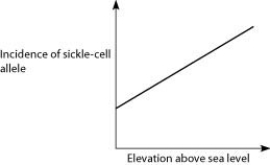
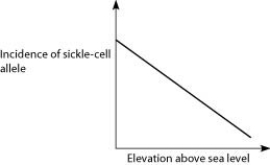
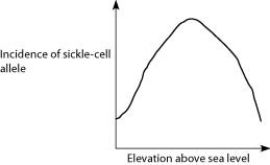
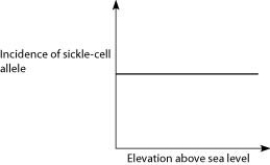
Anopheles mosquitoes, which carry the malaria parasite, cannot live above elevations of 5,900 feet. In addition, oxygen availability decreases with higher altitude. Consider a hypothetical human population that is adapted to life on the slopes of Mt. Kilimanjaro in Tanzania, a country in equatorial Africa. Mt. Kilimanjaro's base is about 2,600 feet above sea level and its peak is 19,341 feet above sea level. If the incidence of the sickle-cell allele in the population is plotted against altitude (feet above sea level) , which of the following distributions is most likely, assuming little migration of people up or down the mountain?


A) Anopheles mosquitoes, which carry the malaria parasite, cannot live above elevations of 5,900 feet. In addition, oxygen availability decreases with higher altitude. Consider a hypothetical human population that is adapted to life on the slopes of Mt. Kilimanjaro in Tanzania, a country in equatorial Africa. Mt. Kilimanjaro's base is about 2,600 feet above sea level and its peak is 19,341 feet above sea level. If the incidence of the sickle-cell allele in the population is plotted against altitude (feet above sea level) , which of the following distributions is most likely, assuming little migration of people up or down the mountain? A)    B)    C)    D)
B) Anopheles mosquitoes, which carry the malaria parasite, cannot live above elevations of 5,900 feet. In addition, oxygen availability decreases with higher altitude. Consider a hypothetical human population that is adapted to life on the slopes of Mt. Kilimanjaro in Tanzania, a country in equatorial Africa. Mt. Kilimanjaro's base is about 2,600 feet above sea level and its peak is 19,341 feet above sea level. If the incidence of the sickle-cell allele in the population is plotted against altitude (feet above sea level) , which of the following distributions is most likely, assuming little migration of people up or down the mountain? A)    B)    C)    D)
C) Anopheles mosquitoes, which carry the malaria parasite, cannot live above elevations of 5,900 feet. In addition, oxygen availability decreases with higher altitude. Consider a hypothetical human population that is adapted to life on the slopes of Mt. Kilimanjaro in Tanzania, a country in equatorial Africa. Mt. Kilimanjaro's base is about 2,600 feet above sea level and its peak is 19,341 feet above sea level. If the incidence of the sickle-cell allele in the population is plotted against altitude (feet above sea level) , which of the following distributions is most likely, assuming little migration of people up or down the mountain? A)    B)    C)    D)
D) Anopheles mosquitoes, which carry the malaria parasite, cannot live above elevations of 5,900 feet. In addition, oxygen availability decreases with higher altitude. Consider a hypothetical human population that is adapted to life on the slopes of Mt. Kilimanjaro in Tanzania, a country in equatorial Africa. Mt. Kilimanjaro's base is about 2,600 feet above sea level and its peak is 19,341 feet above sea level. If the incidence of the sickle-cell allele in the population is plotted against altitude (feet above sea level) , which of the following distributions is most likely, assuming little migration of people up or down the mountain? A)    B)    C)    D)

E) A) and B)
F) A) and C)

Correct Answer

verifed

verified

If individuals tend to mate within a subset of the population, there is ________.


A) no selection
B) no genetic drift
C) no gene flow
D) random mating

E) A) and B)
F) None of the above

Correct Answer

verifed

verified

In a Hardy-Weinberg population with two alleles, A and a, that are in equilibrium, the frequency of the allele a is 0.3. What is the frequency of individuals that are homozygous for this allele?


A) 0.09
B) 0.49
C) 0.9
D) 9.0

E) C) and D)
F) A) and B)

Correct Answer

verifed

verified

The inability of organisms to evolve anything that could be an advantage reflects ________.


A) the limits of choices of genes within a species
B) the inability to compromise
C) the consequences of random mutations
D) the consequences of inbreeding

E) B) and C)
F) All of the above

Correct Answer

verifed

verified

Which Hardy-Weinberg condition is affected by population size?


A) selection
B) genetic drift
C) gene flow
D) no mutation

E) A) and D)
F) B) and C)

Correct Answer

verifed

verified

Which of the following is the best modern definition of evolution?


A) descent with modification
B) change in the number of genes in a population over time
C) survival of the fittest
D) inheritance of acquired characters

E) All of the above
F) None of the above

Correct Answer

verifed

verified

The Dunkers are a religious group that moved from Germany to Pennsylvania in the mid-1700s. They do not marry with members outside their own immediate community. Today, the Dunkers are genetically unique and differ in gene frequencies, at many loci, from all other populations including those in their original homeland. Which of the following mechanisms likely explains the genetic uniqueness of this population?


A) population bottleneck and Hardy-Weinberg equilibrium
B) heterozygote advantage and stabilizing selection
C) mutation and natural selection
D) founder effect and genetic drift

E) A) and D)
F) A) and B)

Correct Answer

verifed

verified

HIV's genome of RNA includes the code for reverse transcriptase (RT) , an enzyme that acts early in infection to synthesize a DNA genome off of an RNA template. The HIV genome also codes for protease (PR) , an enzyme that acts later in infection by cutting long viral polyproteins into smaller, functional proteins. Both RT and PR represent potential targets for antiretroviral drugs. Drugs called nucleoside analogs (NA) act against RT, whereas drugs called protease inhibitors (PI) act against PR. Which mechanism produces variation for evolution by shuffling existing alleles?


A) rapid reproduction
B) sexual reproduction
C) mutation
D) changes in chromosome numbers

E) A) and B)
F) A) and C)

Correct Answer

verifed

verified

Suppose 64% of a remote mountain village can taste phenylthiocarbamide (PTC) and must, therefore, have at least one copy of the dominant PTC taster allele. If this population conforms to Hardy-Weinberg equilibrium for this gene, what percentage of the population must be heterozygous for this trait?


A) 16%
B) 32%
C) 40%
D) 48%

E) A) and B)
F) A) and C)

Correct Answer

verifed

verified

Showing 1 - 20 of 64

Related Exams

Show Answer